Refresh key Non-Slew Crane knowledge commonly assessed during a High Risk Work VOC. This page provides assessment-aligned guidance and a knowledge check to help you feel prepared.
⚠️ For knowledge refresh only. This does not replace training, site procedures or competency assessment. Voceed accepts no liability for misuse. View full disclaimer.
Section 1 – Crane Safety, Lift Planning & Site Rules
This section covers the core safety principles required when operating a non-slewing crane. It focuses on planning lifts, identifying hazards, and following site rules to ensure all lifting activities are carried out safely. Understanding these fundamentals is critical for preventing incidents and meeting VOC requirements.
1. What should you do if personal situations are distracting you from your work?
Stop and discuss the issue with your supervisor.
2. Who is permitted to stop a lift?
Anyone can stop a lift.
3. What is the best way to identify hazards in the workplace during the pre-planning for a lift?
By using the pre-lift assessment.
4. When must you participate in a pre-lift assessment?
Before every lift.
5. When is it acceptable to lift the crane boom or load over personnel?
Never.
6. If directed, would you use the crane hook to drag/pull a load while the load is on the ground?
No, never under any circumstances.
7. What would you do if you observed lightning or heard thunder while lifting?
All lifting operations cease ASAP, when the situation with the lift has been made safe.
8. What would you do if windy conditions made the object you were lifting difficult to control?
Cease the lifting operation ASAP when the lift has been made safe.
9. What HAZARD CONTROL STRATEGIES would need to be included in the plan for crane operations?
Any site hazards that will affect the safe operation of the crane such as:
trenches and recently back-filled ground;
poor ground conditions;
other workgroups;
traffic;
poor lighting;
powerlines;
obstructions in the working radius of the boom;
trees;
scaffold;
ladders;
access and exit points.
10. Are you permitted to allow a person to ride upon the lifting hook, sling attachment, or suspended load?
No.
Section 2 – Crane Setup, Operation & Load Control
This section focuses on how to correctly set up and operate a non-slewing crane. It includes understanding how different factors affect crane capacity, how to control loads safely, and how to interpret load charts. These are critical skills for real-world crane operation and assessment.
11. What effect does a side slope have on the rated capacity of the crane?
It de-rates the capacity.
12. What effect does increasing boom length have on the crane?
It de-rates the capacity of the crane.
13. What is the effect on the rated capacity of cranes when articulated more than 10 degrees either side of centre?
The rated capacity is decreased.
14. How would you determine how close to a trench or embankment you are allowed to operate?
The formula is: 1 to 1 (i.e. 1m deep = 1 metre away from the edge of trench/embankment).
15. When taking the weight, how can you ensure that the rope is as close to vertical as possible?
Have the Dogger/Rigger stand at 90 degrees to the boom in clear view of the operator to check.
16. How would you leave a crane parked up off the job?
As per manufacturer and site requirements.
17. How should the boom be left when a non-slewing crane is parked up?
As per manufacturers specifications and site rules. Usually raised up high enough to avoid contact with other mobile plant, vehicles and personnel.
18. What sort of ground is suitable for pick and carry operations?
Firm, level, flat and smooth ground.
19. If you have a Dogger escorting the crane on foot, where should he/she walk?
Forward to and to the side of the crane out of its path and in full view of the crane operator.
20. What is the minimum amount of rope that should be left on the winch drum when fully wound out?
A minimum of three (3) full turns on the winch drum.
21. When transferring a load from a crane hook to a chain block (say in a building), how much side angle from the line of the boom would you allow?
One (1) degree.
22. Where would you find a crane's rated capacity for a particular boom length at a particular radius?
The crane’s load chart.
23. Where a crane has to lift near powerlines, what two actions can be taken to eliminate or control the hazard created by them?
The power should be isolated and/ or if this is not possible the powerlines MUST be insulated.
Section 3 – Inspection, Maintenance & Rejection of Lifting Equipment
This section covers inspection requirements for cranes and lifting gear. It includes identifying defects, understanding rejection criteria, and maintaining equipment to ensure it remains safe for use. Proper inspection is a key responsibility of all operators.
26. What MECHANICAL defects would you look for during an inspection BEFORE starting up the crane motor?
Structural damage
water and oil leaks
condition of V belts
water level
engine and hydraulic oil levels
loose wheel nuts
battery condition
rope condition
27. Describe what STRUCTURAL defects you would look for during an inspection BEFORE starting up the crane motor?
Cracks around boom hinge points
Cracks around slew pivot points
Damage and cracks to the boom
Cracks and damage to the slew and hinge points
28. When does the crane logbook need to be completed?
Must be filled in every time it’s used.
29. What is the maximum amount of wear permitted in the link of a lifting chain?
10%
30. What will condemn flexible steel wire rope from safe use for lifting purposes?
Discolouration due to excessive heat
10% of wires are broken over a length of 8 x diameter of the rope
Spot welded
Kinked
Affected by heat
Crushed
Knotted
Stretches, locked or does not move freely
Corroded
Stretched
Overloading
Heat affected
Effects of acid or corrosive agents
Acid and alkaline affected
Bird caging
Brittleness
High standing
Cut or broken yarns/strands
Twisted
31. What will condemn soft synthetic sling from safe use for lifting purposes?
Acid and alkaline affected
Sun-rot
Mildew
Heat affected
Affects of acid or corrosive agents
Overloading
32. When should slings be inspected?
At all times before and after using the slings.
33. What would you do with a defective sling?
Tag out of service and separate from usable equipment.
This section focuses on slinging techniques, load handling, and the calculations required to lift safely. It includes understanding sling angles, load distribution, and selecting the correct equipment. These concepts are essential for dogging and rigging competency.
34. When a three-legged sling is used to lift a rigid load, how many legs are assumed to be taking the weight?
2
35. Before a round load is released, what would you do to stop it from rolling away?
Chock it to prevent rolling
36. Which is the safest method of slinging a load of pipes?
Double wrap two slings and reeve the eye.
37. How do you determine the maximum angle of a four legged sling?
The greater angles between any opposite diagonal sling legs. You can learn more about sling angles from the Voceed Toolbox.
38. In slinging a load, what action would you take to ensure the load was secure before hoisting the load to the top of the building?
Conduct a test lift to ensure all slinging are tightly secured.
39. Which of the following formulas is correct for flexible steel wire rope?
Diameter x Diameter x 8 = SWL
40. What method can you use to determine a 60 degree included angle between the sling legs?
The length of each sling leg is equal to the distance between the two lifting points (equilateral triangle).
41. Is it permissible to reeve a sling through two or more eyebolts?
No.
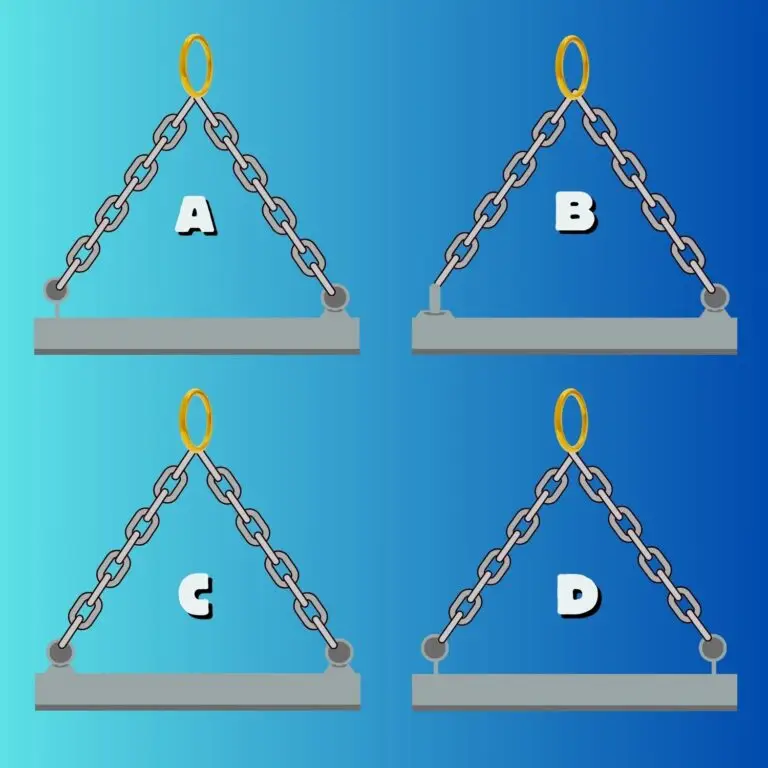
42. Which is the correct method of using eyebolts with a two-legged sling configuration?
Reveal Answer
C is the correct answer.
43. What type of shackle would you use for multiple slings?
Bow shackle.
44. What is the reduction in the SWL of a sling when choked around a round load?
25%
45. Would you use an eyebolt to lift an electric motor?
No, it is not designed to lift a motor unless rated to do so. Check with the manufacturer for clarification prior to lifting.
46. What does a cubic metre of water weigh?
1 tonne.
47. What does a cubic metre of concrete weigh?
2.4 tonne.
48. What does a cubic metre of steel weigh?
7.8 tonne.
End of Questions
Was this helpful?
Quick one-tap feedback for users on site.
Practice with a written test
Let’s be honest, we can’t do our written test in front of a screen. Why not get serious and try a more realistic approach! Download and print off your hardcopy here.