
Chapters
What is the 3m, 6m, 8m Powerline Rule?

The 3m, 6m, 8m rule is a simplified way to remember safe working distances when operating cranes, Elevated Work Platforms (EWPs), and other mobile plant near overhead powerlines.
- 3 metres → Minimum distance when a trained spotter is in place
- 6 metres → Standard safe working distance for most distribution lines
- 8 metres or more → Required for higher voltage transmission lines
This rule is commonly used on-site and in VOC (Verification of Competency) assessments to ensure operators maintain safe clearances.
Why powerline clearance distances matter
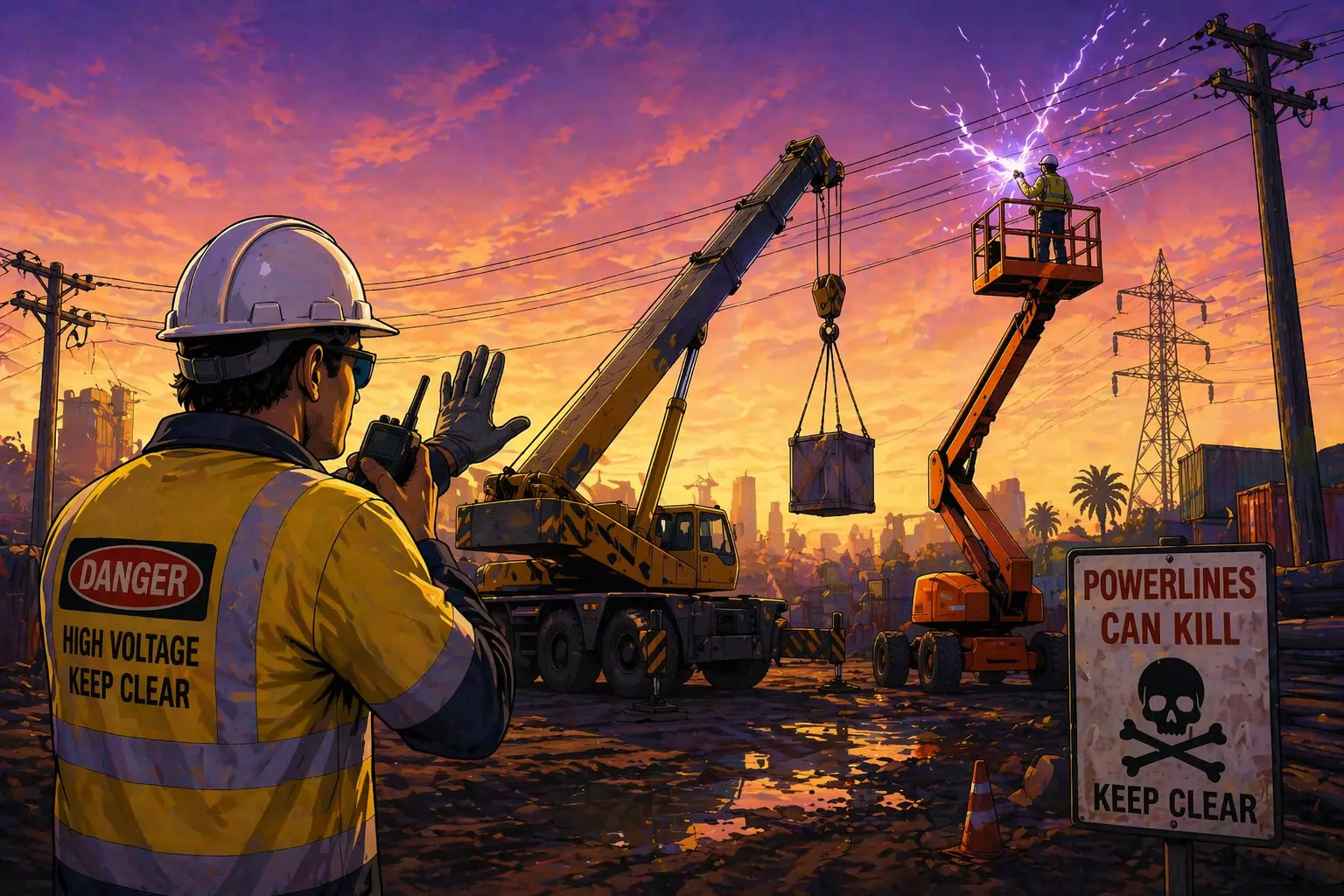
Working near overhead powerlines presents a serious risk of electrocution, arcing, and equipment damage.
Electricity can:
- Arc across gaps without direct contact
- Travel through crane booms, loads, or EWP baskets
- Cause fatal injuries instantly
Even if you do not touch the line, getting too close can still be deadly.
Maintaining correct clearance distances is critical to:
- Protect workers and operators
- Prevent equipment damage
- Ensure compliance with Australian safety laws.
Understanding powerline clearance distances is essential across multiple high-risk work disciplines and is commonly assessed in VOCs for dogging, rigging, and scaffolding. Whether directing loads as a dogman, planning lifts as a rigger, or erecting structures near overhead lines as a scaffolder, workers must be able to identify exclusion zones, apply minimum approach distances, and understand the risks of electrical contact or arcing. These scenarios are frequently tested in site-based assessments, making powerline safety knowledge critical not just for compliance, but for passing your VOC and working safely on site.
Watch: Powerline Safety Explained
This video from SafeWork SA highlights the importance of maintaining safe approach distances when working near overhead powerlines.
It forms part of the Avoiding Utility Strikes toolbox series and provides a practical overview of the risks, including minimum safe distances for workers and machinery.
Australian Standard Clearance Distances (AS2550.1)

Under AS2550.1:2011, the general exclusion zones are:
Distribution Lines (up to 133kV)
- 6.4 metres minimum clearance
- Can be reduced to 3.0 metres with a qualified spotter
Transmission Lines (above 133kV)
- 10 metres minimum clearance
- Can be reduced to 8.0 metres with a qualified spotter
These distances apply to cranes and are commonly adopted across other mobile plant.
State-by-state powerline clearance rules
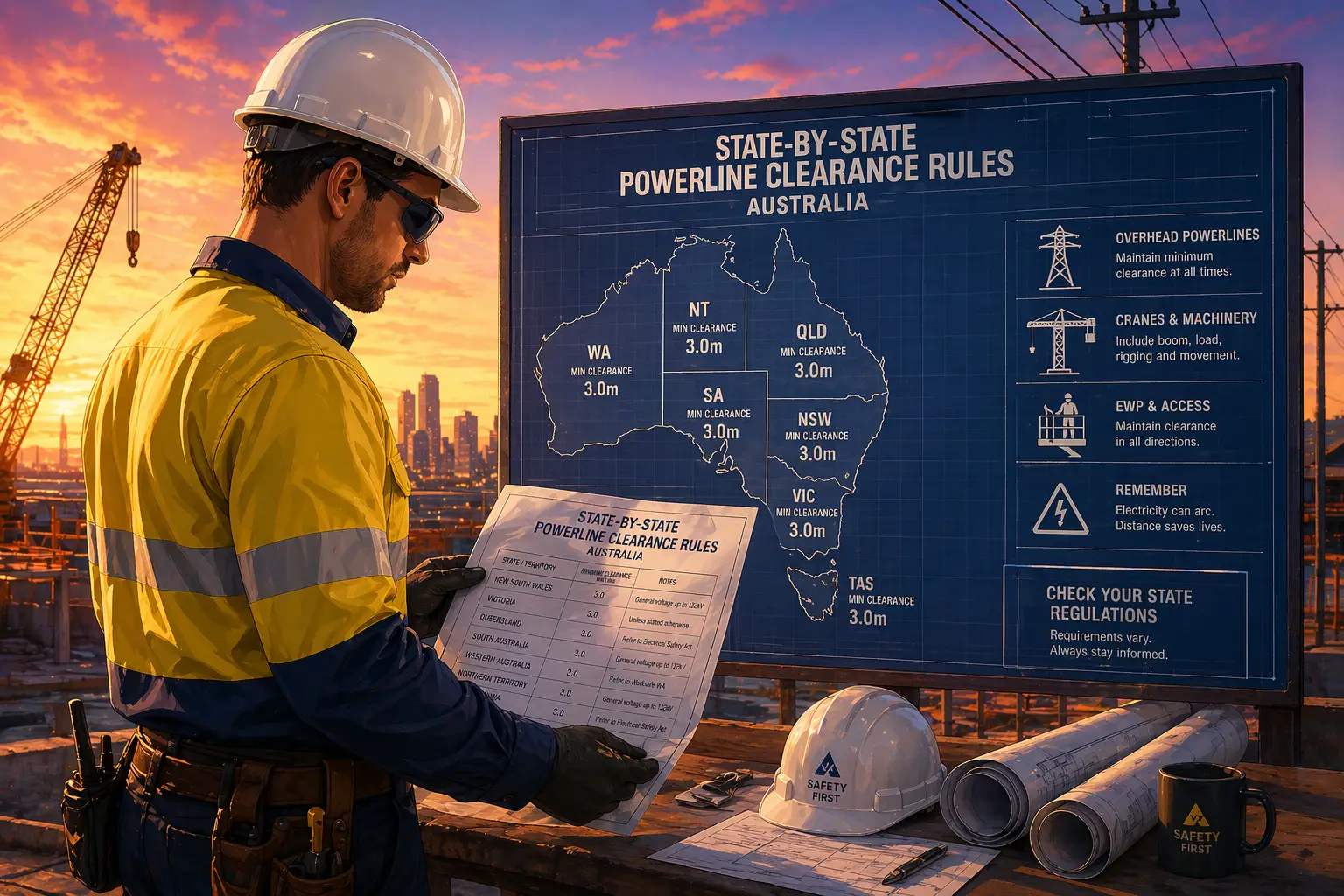
While Australian Standards provide guidance, each state has its own regulations.
| State / Territory | Voltage Range | Exclusion Zone (Hard No-Go) | Safety Observer / Spotter |
|---|---|---|---|
|
Queensland
Workplace Health & Safety QLD Electrical Safety Regulation 2013 + Code of Practice 2020 |
Up to 132kV | 3.0m | ⚠ Safety Observer Zone Within 10m either side of powerline where plant could breach exclusion zone |
| 132kV – 330kV | 6.0m | ⚠ Safety Observer Zone Within 10m either side of powerline where plant could breach exclusion zone | |
| 330kV – 500kV | 8.0m | ⚠ Safety Observer Zone Within 10m either side of powerline where plant could breach exclusion zone | |
|
New South Wales
SafeWork NSW Code of Practice 2006 |
Up to 132kV | 3.0m | ↑ Recommended Safety observer strongly recommended. No formally defined spotter zone distance |
| 132kV – 330kV | 6.0m | ↑ Recommended Safety observer strongly recommended. No formally defined spotter zone distance | |
| Above 330kV | 8.0m | ↑ Recommended Safety observer strongly recommended. No formally defined spotter zone distance | |
|
Western Australia
DMIRS WorkSafe WA Electricity Regulations 1947, Reg 316A |
Less than 33kV | 3.0m | ↑ Recommended Safety observer recommended as control measure. No formally defined spotter zone distance |
| 33kV – 133kV | 6.0m | ↑ Recommended Safety observer recommended as control measure. No formally defined spotter zone distance | |
| Above 133kV | 8.0m | ↑ Recommended Safety observer recommended as control measure. No formally defined spotter zone distance | |
|
Northern Territory
NT WorkSafe Electrical Safety Regulations 2024 |
Up to 33kV | 1.5m | ↑ Recommended No formally defined spotter zone distance |
| 33kV – 132kV | 3.0m | ↑ Recommended No formally defined spotter zone distance | |
| 132kV – 275kV | 4.0m | ↑ Recommended No formally defined spotter zone distance | |
| 275kV – 330kV | 6.0m | ↑ Recommended No formally defined spotter zone distance | |
| 330kV – 500kV | 8.0m | ↑ Recommended No formally defined spotter zone distance | |
| Victoria, South Australia, Tasmania & ACT — Regulated by Energy Safe Victoria, SafeWork SA, WorkSafe Tasmania & WorkSafe ACT. Victoria operates its own No Go Zone (NGZ) framework with formally defined spotter zones. SA, TAS & ACT follow AS2550.1:2011. | |||
|
Victoria
Energy Safe Victoria No Go Zone Framework |
Distribution lines Up to 66kV | 3.0m | ⚠ Spotter Required Between 3.0m – 6.4m from powerline (ESV registered spotter mandatory) |
| Transmission lines 132kV – 500kV | 8.0m | ⚠ Spotter Required Between 8.0m – 10.0m from powerline (ESV registered spotter mandatory) | |
|
SA · TAS · ACT
SafeWork SA / WorkSafe TAS / WorkSafe ACT AS2550.1:2011 |
Distribution lines Up to 133kV | 6.4m | ⚠ Spotter Required Reduces to 3.0m with qualified spotter (AS2550.1:2011) |
| Transmission lines Above 133kV | 10.0m | ⚠ Spotter Required Reduces to 8.0m with qualified spotter (AS2550.1:2011) | |
What is a spotter, and when are they required?

A spotter is a trained and competent person responsible for ensuring plant does not breach exclusion zones.
A spotter must:
- Maintain constant visual contact with the plant
- Communicate clearly with the operator
- Understand minimum approach distances
- Stop work if unsafe conditions occur
Spotters allow reduced distances but do not eliminate risk.
Safety considerations when working near powerlines
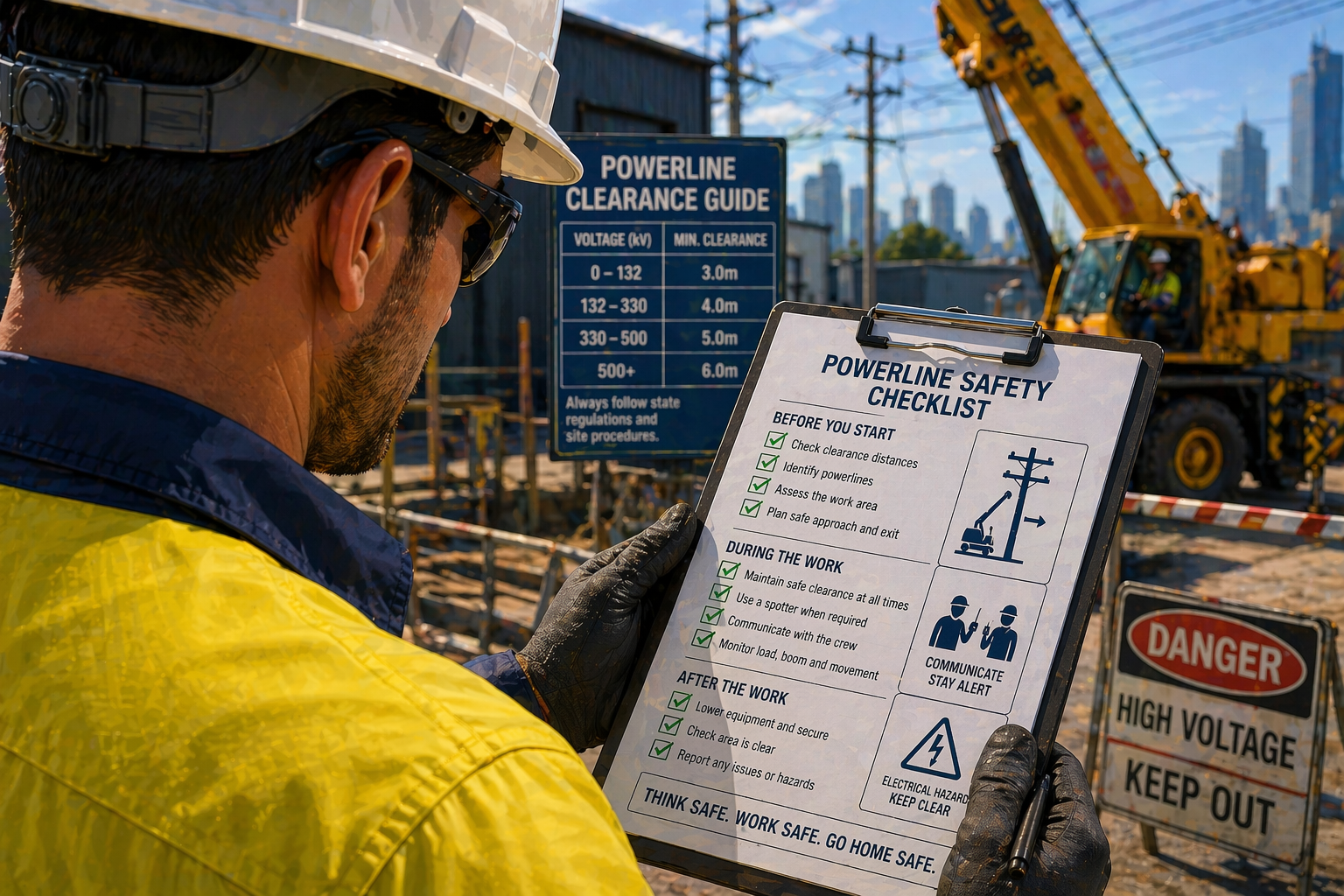
Can You Work Over Powerlines?
Working directly over live powerlines is not permitted unless:
- The power has been isolated, OR
- Approval has been obtained from the electrical authority
Always contact your local electricity provider before planning work near powerlines.
Does This Apply to Other Mobile Equipment?
Yes. These clearance rules apply to:
- Cranes
- Elevated Work Platforms (EWPs)
- Telehandlers
- Excavators
- Forklifts
- Trucks and tipper vehicles
Any mobile plant operating near overhead powerlines must maintain safe distances.
Common Mistakes When Working Near Powerlines
- Underestimating boom movement or load swing
- Forgetting wind can move loads closer to lines
- Not using a spotter when required
- Relying on visual judgement instead of measured distances
On Site Tip
Most incidents occur when operators focus on the load—not the powerlines. Always plan your lift with clearance in mind before starting work.
Quick recap
What is the minimum distance allowable to work near powerlines?
The minimum distance is 3 metres with a trained spotter, but standard safe distances are typically 6.4 metres or more depending on voltage.
What is the 3m, 6m, 8m rule?
It’s a simple rule used to remember safe distances: 3m with a spotter, 6m standard, and 8m+ for high voltage lines.
Can electricity arc without touching the powerline?
Yes—electricity can arc across gaps, meaning you don’t need to touch the line to be electrocuted.
Can you operate a crane, EWP or any other mobile equipment over powerlines?
No—unless the line is isolated or approval has been given by the electrical authority.
What is a spotter and what do they do?
A spotter is a trained person who ensures plant does not breach powerline exclusion zones.
Does wind affect safe working distances near powerlines?
Yes—wind can cause load swing or boom movement, increasing the risk of breaching clearance distances.
What happens if you breach the exclusion zone?
Breaching clearance distances can result in electrocution, serious injury, or death.
Do these rules apply to all mobile plant?
Yes—these rules apply to cranes, EWPs, excavators, telehandlers, and trucks.
How do you know the voltage of a powerline?
You should never assume voltage—always confirm with the electrical authority or site supervisor.
When must you contact the electrical authority?
Before working close to powerlines or if you need to operate within exclusion zones.
Can a spotter eliminate the risk of powerlines?
No—a spotter reduces risk but does not eliminate it.
What is the safest way to work near powerlines?
Maintain safe distances, use a spotter, and plan work before starting.
Reminder
The information in this guide is provided for general educational purposes only and is based on Australian Standards and publicly available regulatory guidance at the time of writing. It is not a substitute for formal training, site-specific procedures, or professional advice. Requirements may vary depending on location, voltage, site conditions, and governing authority. Always confirm current requirements with your employer, site supervisor, and the relevant electrical authority before commencing any work near powerlines.
Resources & references:
National Guidance
- Safe Work Australia. (n.d.). Electrical risks and working near overhead powerlines.
- Working in the vicinity of overhead and underground electric lines information sheet.
Queensland
- Workplace Health and Safety Queensland. (2020). Electrical Safety Code of Practice: Working near overhead and underground electric lines.
https://www.worksafe.qld.gov.au - Exclusion Zones
New South Wales
- SafeWork NSW. (n.d.). Working near overhead powerlines. https://www.safework.nsw.gov.au
Victoria
- Energy Safe Victoria. (n.d.). Electrical safety guidance for working near powerlines.
https://www.esv.vic.gov.au - Working near powerlines – Important information for non-electric workers who work near powerlines.
- Electrical Safety (Installations) Regulations 2009 – Statutory Rule Number 164/2009
Western Australia
- DMIRS WorkSafe WA. (n.d.). Working safely near overhead powerlines.
https://www.dmirs.wa.gov.au
South Australia
- SafeWork SA. (n.d.). Electrical safety and powerline hazards.
https://www.safework.sa.gov.au - Avoiding Utility Strikes – Toolbox 4: Working near overhead powerlines. YouTube Video here.
Tasmania
- WorkSafe Tasmania. (n.d.). Electrical safety in the workplace.
https://worksafe.tas.gov.au
Northern Territory
- NT WorkSafe. (n.d.). Electrical safety and working near powerlines.
https://worksafe.nt.gov.au
ACT
- WorkSafe ACT. (n.d.). Electrical safety guidance.
https://www.worksafe.act.gov.au
Australian Standards
- AS2550.1:2011 – Cranes, hoists and winches – Safe use (General requirements)