Refresh key dogging knowledge commonly assessed during a High Risk Work VOC. This page provides assessment-aligned guidance and a knowledge check to help you feel prepared.
This content supports knowledge refresh only and does not replace on-site training or physical competency assessment. Voceed accepts no responsibility for the misuse of this information. View our full disclaimer here.
This section focuses on identifying and controlling hazards commonly encountered during dogging operations. You are expected to understand environmental risks, exclusion zones, overhead services, ground conditions, and safe work practices that protect both personnel and equipment.
Assessors use these questions to confirm your ability to recognise risk and implement appropriate control measures before and during lifting operations.
1. Which has greater bearing pressure, soft clay or dry sand?
Dry sand.
2. Which has greater bearing pressure, shale or dry sand?
Shale.
3. Which has greater bearing pressure, dry clay or gravel?
Gravel.
4. What three hazards would you check for before a crane is taken off-road?
Any three of the following:
Potholes;
Soft or rough ground;
Overhead obstructions;
Powerlines;
Personnell working in the area;
Traffic flow and direction;
Underground services and;
Pedestrians.
5. When operating near powerlines, which type of tagline would you use; natural fibre rope or a synthetic fibre rope? Explain your answer.
Natural fibre rope (Because it is non-conductive). Always maintain safe clearance distanceswhen working near powerlines.
6. What can happen to the crane boom when releasing a heavy load from under powerlines?
Crane boom could spring up and come into contact with the powerlines.
15. Before placing a heavy load on a floor or temporary formwork and falsework, what should the person dogging the load ensure?
That the load can be safely supported by the floor or formwork/ falsework i.e. back propping.
16. What hazards would you look for when directing a crane onto a site in a built up area?
Powerline clearances;
Other overhead service lines;
Underground services;
Uneven or unstable ground;
Dangerous materials.
17. List six hazards to consider in your crane setup plan when accessing a new area on site.
Powerlines;
Trees;
Overhead service lines;
Bridges;
Surrounding structures;
Obstructions, Facilities;
Other equipment;
Dangerous materials;
Underground services;
Soil conditions, e.g. recently filled trenches;
Vehicle traffic.
18.What hazard control measures would you need to consider in directing and controlling crane movement and loads involving the following:1. Public safety; 2. Vehicles on site; 3. Maintain suitable vision at night?
Warning signs and barriers;
Traffic control measures;
Suitable artificial lights and lighting;
Flag person;
Flashing hazard lights.
19. What PPE is essential for someone dogging loads?
Hardhat;
Gloves;
Steel capped boots;
Eye protection.
20. What protection is needed when lifting over pedestrian footpaths and access?
A hoarding, gantry, or scaffolding.
21. Why is it important to consult with relevant workplace personnel and/ or HSE Advisor prior to commencing work?
To ensure that the workplace rules and procedures are adhered to.
22. What must be obtained prior to commencing crane and dogging tasks on site?
Risk assessments (Take 5, JHA, SWMS), any relevant permits, approval for the work to be performed.
23. Which type of mobile crane is most suitable to pick and carry a load across an unprepared surface?
A rough terrain crane or franna.
Section 2: cranes
This section tests your understanding of crane types, load charts, crane stability, and safe operating principles. You must demonstrate knowledge of crane limitations, communication methods, and factors that affect safe lifting performance.
Assessors are verifying that you understand how crane capacity, setup conditions, and environmental factors directly impact lift safety.
24. When setting up a mobile crane, would you place the top layer of packing in line with the outrigger beam or at 90 degrees?
The top layer of packing should be at 90 degrees to the outrigger beam.
25. What is the minimum thickness of timber required for packing under a crane's outriggers?
75 mm.
26. How should you position each layer of outrigger packing?
At 90 degrees to one another.
27. Where would you find a crane's rated capacity for a specific boom length at a known radius?
The crane’s load chart located in the crane’s cabin.
28. What are two consequences of overloading a mobile crane?
Toppling over (Instability) and;
Structural damage.
29. What risk does a near-vertical crane boom pose when moving up a slope?
It can topple over backwards.
30. When lifting a load, would you use rail clamps instead of outriggers on a locomotive crane?
No.
31. Under what circumstances should you chock a locomotive crane's wheels?
When the locomotive crane is operating on a slope.
32. What is a load chart, and what information does it provide?
It is a chart which must be in the cabin of all cranes which explains the SWL of the crane under all configurations.
33. What does 'operating radius' mean in crane operations?
The distance of the hook from a known point on the crane at which a crane can operate safely with a known load.
34. Give two reasons why snigging a load is not allowed.
Any two of the following answers:
The load can swing uncontrollably towards the crane;
It can cause structural damage to the crane;
It can cause damage to the load;
It can turn the load over and;
It can damage the rigging gear.
35. How do you determine a crane's capacity with a fly jib attached?
By referring to the crane’s load chart.
36. How does a fly jib generally affect a crane's lifting capacity?
It reduces the crane’s lifting capacity – refer to the cranes load chart.
37. How does a fly jib influence the crane's operational reach?
It generally increases the radius – refer to the crane’s load chart.
38. Can you move a loaded crane across a hillside? Explain.
No. It can result in uncontrolled load swing, instability and side pull on the cranes boom and wire rope.
39.When booming/luffing down with a load, what effect does it have on the crane?
Booming/luffing down increases the radius that in turn reduces the crane’s capacity.
40. When mobiling a load, how high must you keep the load and at what speed should you travel?
Always carry the load as close to the ground as possible, use least amount of rope as possible, and travel slowly to reduce the load swing. Refer to operators manual for specified use.
41. Why is it important to fully extend a mobile crane's outriggers?
To maintatin the stability of the crane.
42. What risks do setting outriggers close to an excavation pose?
The possibility of the bank collapsing under the pressure.
43. If a lift box (dog box) is used to lift personnel at height, where must the dogman be positioned?
In the lift box with the worker.
44. Why should a crane carrying a heavy load be directed down a sloping surface backwards?
The crane will have greater stability travelling backwards.
45. Before hoisting a load, where should the top sheave of the crane be in relation to the load?
Directly above the load to be lifted.
46. What is the smallest diameter wire rope sling that can be used to hoist a load?
5 mm.
Section 3: lifting gear
This section examines your knowledge of slings, chains, shackles, hooks, and other lifting components. You are expected to understand inspection requirements, working load limits (WLL), rejection criteria, and correct selection of lifting equipment.
The focus is on ensuring you can identify unsafe gear and select equipment appropriate for the load and lifting configuration.
47. What does "6 x 24 FC RHOL FSWR" mean?
6 strands of 24 wires, fibre core, right hand ordinary lay, flexible steel wire rope.
48. What does "8 x 25 FC LHOL FSWR" mean?
8 strands of 25 wires, fibre core, left hand ordinary lay, flexible steel wire rope.
49. Are the strands of a right-hand lay rope laid clockwise or counterclockwise around the core?
Clockwise.
50. In an ordinary lay FSWR, do the wires lay in the same direction as the strands or in the opposite direction?
The opposite direction.
51. What's the minimum FSWR construction you would use for slings?
6 x 19 (or 6/19).
52. In the construction of rope, does the lay of the rope affect its SWL?
No.
53. Does the lay of a rope affect its spin?
Yes.
54. What letter commonly marks Grade 80 chain?
T.
55. What letter is often used to identify Grade 40 chain?
M.
56. What letter typically marks Grade 30 chain?
L.
57. What is the safe working load for a red synthetic sling in a vertical lift?
5t.
58. What's the safe working load for a green synthetic sling in a vertical lift?
2t.
59. What is the safe working load for a blue synthetic sling in a vertical lift?
8t.
60. What's the smallest diameter of fibre rope you'd use as a tagline?
16 mm.
61. Which shackle type is best for connecting multiple slings?
Bow shackle.
62. What type of eyebolts would you use with multiple leg slings when the pull on the slings is to centre to the axis of the eyebolts?
Collared eye bolts.
63. List at least five defects that would make a fibre rope unsafe for use.
Brittleness;
Discolouration due to excessive heat;
Sun-rot;
Mildew;
Effects of acid or corrosive agents;
Overloading (stretched);
High stranding;
Cut or broken yarns/ strands;
Knotted.
64. What is the smallest diameter of fibre rope allowed for supporting loads?
12 mm diameter.
65. What rule of thumb or formula do you use to determine the SWL of an unidentified synthetic rope?
Diameter in mm squared = the WLL in kg.
NOTE: If unknown, the formula for fibre rope should apply or be accpeted.
66. List at least four defects that would make a flexible steel wire rope (FSWR) unsafe for lifting.
10% of wires are broken over a length of 8 x diameter of the rope;
Kinked;
Sun-rot;
Crushed;
Knotted;
Corroded;
Stretched;
Affected by heat;
Affected by acid and Alkaline;
birdcaging.
67. What formula indicates the maximum number of broken wires allowed in a FSWR?
Where 10% of the total number of wires are broken in one rope lay or in 8 diameters of the rope.
68. Calculate the maximum number of broken wires allowed in a 25mm diameter, 6 x 19 construction FSWR.
Rope diameter = 25 mm
25 x 8 = 200 length
Total number of wires in 6 x 19 construction = 114
10% of 114 = 11.4
Therefore, maximum number of broken wires allowable in a length of 200 mm = 11.
69. What is the highest temperature a FSWR can be exposed to without damage?
Should not exceed 95 degrees celsius.
70. List at least five defects that render a chain unsafe for lifting.
Twisted;
Kinked, knotted;
Stretched, locked or does not move freely;
Gouged, cut or worn more than 10% of the links original diameter;
Pitting;
Affected by heat;
Cracked links;
Spot welded.
71. What are the maximum safe temperatures for Grade 30 and high tensile grade 80 chains?
Grade 30 = 260 degrees Celsius;
Grade 80 = 400 degrees Celsius.
NOTE: If 260 degrees Celsius is exceeded, the WLL of the chain is reduced.
72. What are the smallest diameter alloy chains allowed for safe load handling for Grade 30 and high tensile grade 80 chains?
Grade 30 = 8 mm;
Grade 80 = 6 mm.
73. What is the maximum amount of wear allowable in the link of a lifting chain?
10% wear.
74. What is the maximum amount of stretch allowable in the link of a lifting chain?
10% elongation.
75. What should you do if a set of chains has no SWL tag or both SWL tag and grade markings missing?
Place chains “Out of Service” and engage a lifting gear specialist to re-test and tag gear. If this cannot be done, chains must be removed from use and destroyed.
76. How can you find out the lifting capacity of synthetic webbing slings?
By referring to the SWL tag on the sling.
TIP: Although colour coded slings refer to their relative SWL, it is best to check the tag prior to use. This also ensures the tag is present at the time of use.
77. What factors should be considered when inspecting synthetic webbing slings for safe use? List at least 6 factors.
No external wear or abrasions;
No internal wear – key indicators are the thickness of the sling or the presence of grit and dirt;
No Damage to stitching;
No Damage to eyes, terminal attachments or end fittings;
Checking the Label/ Tag has not been removed, destroyed and is legible;
No Damage to sleeve or protective coating;
Sling has not come into contact with acids, organic solvents such as paint, coal tar or paint stripper etc;
No visible cuts/ tears or contusions.
78. Why should synthetic web slings be twisted when supporting loads?
The SWL is based on the sling being used in a straight formation.
79. What will condemn synthetic slings from safe use for lifting purposes? List at least 5 defects.
No external wear or abrasions;
No internal wear – key indicators are the thickness of the sling or the presence of grit and dirt;
No Damage to stitching;
No Damage to eyes, terminal attachments or end fittings;
Checking the Label/ Tag has not been removed, destroyed and is legible;
No Damage to sleeve or protective coating;
Sling has not come into contact with acids, organic solvents such as paint, coal tar or paint stripper etc;
No visible cuts/ tears or contusions.
80. Name two different types of shackles generally used for lifting purposes.
“D” Shackles;
Bow Shackles.
81. What is the maximum amount of wear permitted in a shackle?
10% of the diameter.
82. Where would you find the SWL of a shackle?
It is marked on the shackle.
83. What will condemn shackles from safe use for lifting purposes? List at least three defects.
Bent;
Deformed;
Damaged;
Cracked;
Cut, gouged or worn by 10% or more;
SWL missing o illegible;
Incorrect fitting pin.
84. Who is responsible for inspecting lifting gear prior to use?
The crane operator;
Dogman and;
Rigger/s.
85. Are you able to give permission for a person to ride upon the lifting hook, rigging gear, or suspended load? Explain.
No, unless a person is secured in a suspended work box which meets all necessary requirements, including relevant statutory requirements.
86. When should lifting gear be inspected?
Prior to every use.
87. What should you do with a flat webbing sling that has had the information tag removed?
Place sling “Out of Service” and return to the manufaturer or relevant specialist for testing and re-tagging.
88. What should your employer do with any chain sling that cannot be repaired?
Destroy it and dispose of correctly.
89. What percentage of wear is permitted in the bite of the hook used on a chain sling?
10%.
90. Up to what percentage increase is permitted in the throat opening of a hook used on a chain sling?
5%.
Section 4: slinging and moving loads
This section covers correct slinging methods, load balance, centre of gravity, and safe load movement. You must understand how to secure loads, control swing, manage multi-leg slings, and communicate effectively during lifting operations.
Assessors use this section to confirm your practical knowledge of load control, stability, and safe coordination during crane lifts.
91. What is the recommended maximum angle between two legs of a sling?
90 degrees.
Learn more about sling angles at the Voceed Toolbox or use our calculator to see how the weight of a load and its sling angle affects sling tension per leg.
92. What is the recommended angle between the vertical and any leg of the sling?
30 degrees.
Learn more about sling angles at the Voceed Toolbox or use our calculator to see how the weight of a load and its sling angle affects sling tension per leg.
93. When a three-legged sling is used to lift a rigid load, how many legs are assumed to be taking the weight?
Two legs must be capable to take the loads weight.
94. When you apply a shackle to a cranes hook, should the pin rest on the hook or does the crown rest on the hook?
The pin.
95. How would you protect a sling when it is resting on or coming into contact with a sharp edge?
Use packing for sharp edges (Lagging, dunnage, carpet, rubber, kevlar).
96. What is the maximum evenly distributed load you would place on a standard hardwood lifting pallet?
Up to 2t (2000 kg).
97. When lifting a pallet of bricks, what lifting device would you use to prevent the loose bricks from falling?
A brick cage.
98. What could happen to formwork if a kibble load of concrete was discharged in one spot?
The formwork can be overloaded and fail/ collapse.
99. What minimum distance would you keep between stacked loads and a railway track?
3m.
100.What minimum distance would you keep between stacked loads and a walkway?
1m.
101. What minimum distance would you keep between stacked loads and a truck access?
3.5m.
102. Before de-rigging a round load, what would you do to it prior to stop it from rolling away?
Chock the load.
103. When mobiling with a load, would you keep the load close to the boom or close to the ground?
Keep the load as close to the ground as possible.
104. When mobiling with a load, how would you stop the load from swinging uncontrollably?
Bridle the load back to the crane.
105. What are three different methods for lifting steel sheet plate?
Two-legged slings;
Maximum sling angle of 60 degrees;
Plate clamps;
Shackles;
Spreader beams.
106. What is the safest method of slinging up a load of pipes?
Two slings must be used;
Double wrap the load;
Use a choke hitch.
107. What is the correct method of lifting a loose bundle of steel?
Double wrap the load with a choke hitch;
Ensure bites are in the same direction.
Ensure sling legs are not resting on and applying pressure to safety latches.
108. Two cranes are dual-lifting a column (Top and Tail) into position. What High Risk License must the person in charge of the lift hold?
An Intermediate Rigging license (RI).
109. What would you use to hoist pallets of bricks or blocks to the floors of a building?
A certified brick cage or materials box.
110. What could you use to safely lift a long bundle of roof sheeting onto the roof of a building?
A spreader beam or long legged slings.
111. How would you determine the lifting points for long precast concrete beams?
As determined and marked by the manufacturer/ Engineer.
112. How does increasing the angle between two slings affect its WLL?
It reduces the WLL of the slings.
Learn more about sling angles at the Voceed Toolbox or use our calculator to see how the weight of a load and its sling angle affects sling tension per leg.
113. How would you determine the maximum angle of a four-legged sling?
The greater of the two angles between any of the two opposite diagonal legs of the slings.
Learn more about sling angles at the Voceed Toolbox or use our calculator to see how the weight of a load and its sling angle affects sling tension per leg.
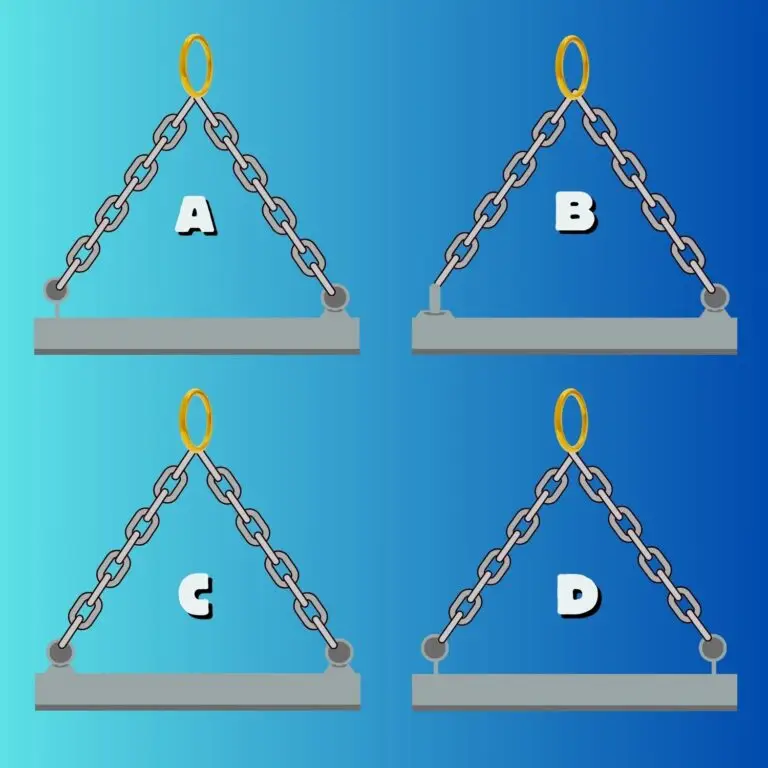
114. From the examples below, select the angle which is closest to 90 degrees.
Reveal Answer
D is the correct answer.
Learn more about sling angles at the Voceed Toolbox or use our calculator to see how the weight of a load and its sling angle affects sling tension per leg.
115. What type of eyebolts would you use to connect two slings to a load where the lift is not vertical?
Collared eyebolts.
116. When two slings are used to lift a load, what are the three main factors that determine the length and capacity of the slings required?
The weight of the load;
The included angle between the slings;
The method of slinging the load i.e. load factor.
117. When using a flexible steel wire rope (FSWR) sling, what is the reduction of the lifting capacity when it is choked around a square load?
50% reduction.
118. What load factor should be applied when a FSWR is choked around a round load?
0.75
119. What is the reduction to the WLL as a result of using a choked hitch around a round load?
25%.
120. What load factor should be applied when using as natural fibre rope sling in a basket hitch around a round load?
A load factor of 2.
121. What load factor should be applied when using two slings directly attached to a load at an included angle of 120 degrees?
An angle factor of 1.
Learn more about sling angles at the Voceed Toolbox or use our calculator to see how the weight of a load and its sling angle affects sling tension per leg.
122. What load factor should be applied when using two slings directly attached to a load at an included angle of 60 degrees?
An angle factor of 1.73
Learn more about sling angles at the Voceed Toolbox or use our calculator to see how the weight of a load and its sling angle affects sling tension per leg.
123. What type of slinging method would you use when using un-collared eyebolts?
Slings should be in a vertical configuration only.
124. Select the correct configuration when using a two legged sling with eye-bolts.
Reveal Answer
C is the correct answer.
125. When slinging loads, what action would you take to determine if the load is safe to lift on top of a building?
Perform a dummy lift – Lift load marginally off the ground and check to see if it is safe.
126. When on the job, what method or rule of thumb could you use to determine if the included angle between the sling legs is 60 degrees?
The distance between the two lifting points on the load is equal to the length of one sling leg.
Learn more about sling angles at the Voceed Toolbox or use our calculator to see how the weight of a load and its sling angle affects sling tension per leg.
End of Questions
Was this helpful?
Quick one-tap feedback for users on site.
Practice with a written test
Let’s be honest, we can’t do our written test in front of a screen. Why not get serious and try a more realistic approach! Download and print off your hardcopy here.