

Chapters
- What is an included Sling Angle
- Why do sling angles increase sling tension?
- How to calculate sling tension
- Typical Angle Factors
- Understanding how the angle factor is calculated
- How the angle factor is applied to calculate sling tension
- Calculate sling tension at any angle
- Determining the maximum load that can be lifted
- Sling angle recommendations in Australia
- 3-Leg and 4-leg sling considerations
- Reeve factors
- The importance of a rigging cheat sheet
- Quick Recap
- Sling angle factor calculator
What is an included sling angle?

The included angle is the angle formed between two sling legs connected to a load. With multiple slings, it is the largest angle, typically diagonally across.
In a symmetrical two-leg lift:
Smaller angle = lower sling tension
Larger angle = higher sling tension
The angle is measured at the top connection point between the two sling legs — not at the load.
This distinction is important in VOC exams which is why we have included questions relating to sling angles our dogging VOC.
Why do sling angles increase sling tension?
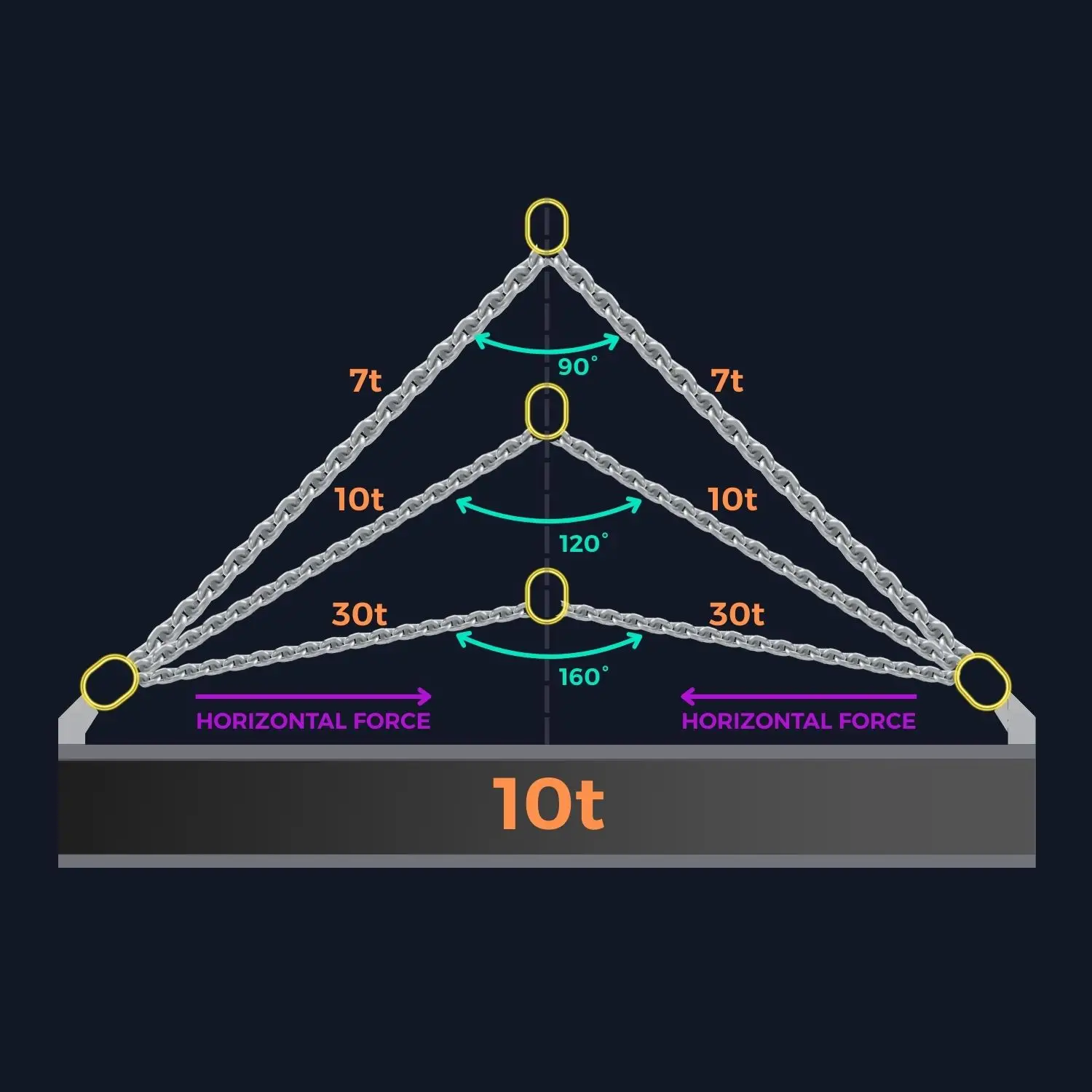
All multi-leg slings generate two forces:
Vertical force (lifting the load) ↑↓
Horizontal force (pulling outward) ←→
As the sling legs flatten:
Horizontal forces increase
Sling tension increases
Hardware and anchor stress increases
The load weight does not change — but the force in each leg does.
This is why flatter lifts are dangerous.
How to calculate sling tension

Now that we understand why sling tension increases as the included angle increases, the next step is knowing how to calculate that tension in practice.
In Australian dogging and rigging training, this is done using Angle Factors.
Angle factors allow doggers and riggers to quickly calculate sling leg tension without needing to use trigonometry on site.
These factors are an important tool for doggers and riggers to ensure correct sling/ rigging gear is selected for the load to be lifted.
Note: The mathematics shown here is for understanding only—on site, doggers and riggers typically rely on standard angle factor charts, so there is no need to feel overwhelmed by the calculations.
Typical angle factors
In Australian dogging and rigging practice, angle factors are commonly used to quickly estimate sling leg tension without needing to run trigonometry on site.
The table below shows the typical angle factors used for two-leg and multi-leg lifts at common included angles.
| Included Angle | Typical Angle Factor | Australian Practice Guidance |
|---|---|---|
| 60° | 1.73 | Preferred |
| 90° | 1.41 | Maximum Recommended |
| 120° | 1.00 | Maximum Permitted (Not Recommended) |
Understanding how the angle factor is calculated
Angle factors represent the multiplier applied to the weight of the load to determine the tension in each sling between two legs of the largest included angle.
Although we understand there are going to be lifts with two or more sling legs, its also important to remember that only two are assumed to be taking the weight.
This eliminates any risk of overloading one or more sling legs which could lead to catastrophic failure.
Formulas for the angle factor
Angle Factor = 2 x sin(Included Angle)
OR
Angle Factor = 2 x cos(half the Included Angle)
Here is the breakdown to find the angle factor for 60°
Method 1:
Start with the included angle 60°
Find the sine (sin) of the included angle (DEG Mode Calculator) = sin(60) = 0.866
Multiply by 2 = 1.7320
Round to 2 decimal places = 1.73
Method 2:
Start with the included angle = 60°
Halve it = 60° ÷ 2 = 30°
Find the cosine (cos) of the half angle (DEG Mode Calculator) = cos(30) = 0.8660
Multiply by 2 = 1.7320
Round to 2 decimal places = 1.73
You now have an understanding of how the following angle factors have been calculated:
| Included Angle | Half Included Angle | cos(Half Included Angle) | 2 × cos(Half Included Angle) |
|---|---|---|---|
| 60° | 30° | 0.866 | 1.73 |
| 90° | 45° | 0.707 | 1.41 |
| 120° | 60° | 0.5 | 1.00 |
How the angle factor is applied to calculate sling tension
Now that we understand the angle factors for different included angles, we can apply them directly to the load weight to determine the tension in each sling leg.
Formula to find sling tension
Sling Tension per Leg = Load ÷ Angle Factor
Example
A steel beam weighing 10 tonnes is to be lifted using a simple symmetrical two-leg lift with an included angle of 60°.
The angle factor for 60° is 1.73.
To calculate the sling tension in each leg:
10 ÷ 1.73 = 5.78 tonnes
Each sling leg will therefore experience 5.78 tonnes of tension.
Selecting the Appropriate Slings
Now that the sling tension is known, we can select suitable slings for the task.
When using soft slings, there is no standard sling with a Working Load Limit (WLL) of 5.78 tonnes.
Because slings must never be overloaded, the calculated tension must be rounded up — never down.
Therefore:
2 × 6-tonne slings would be required.
This ensures each sling’s WLL exceeds the calculated tension of 5.78 tonnes
Calculate sling tension at any angle

Before you rig it, run the numbers.
This interactive tool shows how sling angle directly impacts leg tension, helping you make safer lifting decisions on site.
Sling Angle Factor Calculator

Understand Sling Angle Factors
Adjust the angle and load below to see exactly how sling geometry multiplies leg tension — and why angles matter on every lift.
| Angle (θ) | Angle Factor | Risk | Your Tension |
|---|
Determining the maximum load that can be lifted
So far, we have calculated the sling tension for a known load at a specified included angle.
However, it is also possible to determine the maximum load that can be lifted when the Working Load Limit (WLL) of the slings is already known. This allows doggers and riggers to confirm whether a lift is feasible at a given included angle before proceeding.
This is simply the original equation rearranged.
We know:
Sling Tension per Leg = Load ÷ Angle Factor
Rearranging the formula:
Maximum Load = Sling WLL × Angle Factor
Using our example:
Sling WLL = 6 tonnes
Included angle = 60°
Angle Factor = 1.73
Maximum Load = 6 × 1.73
= 10.38 tonnes
This means that, under ideal balanced lifting conditions, two 6-tonne slings used at a 60° included angle could theoretically lift up to 10.38 tonnes.
For a 10-tonne beam, this provides approximately 0.38 tonnes (380 kg) of theoretical capacity margin.
It is important to understand that this value is theoretical only and assumes a symmetrical lift with no dynamic effects — in practice, factors such as reeve reductions, shock loading, load movement, unequal load distribution, and hardware limitations must all be considered before confirming lift capacity.
Sling angle recommendations in Australia
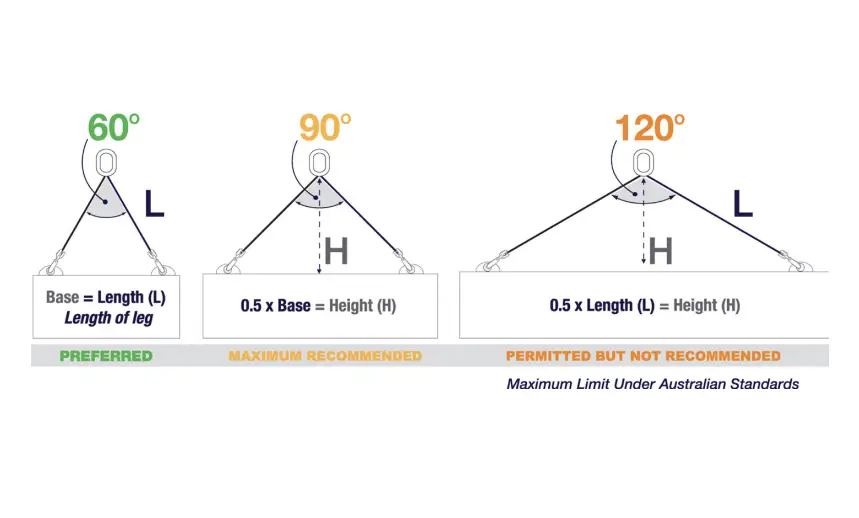
Source: Bullivants, RigCheck Card 2025. Used for educational reference.
In Australian lifting practice:
- 60° is the preferred included angle
- 90° is generally the maximum recommended
- 120° is the absolute maximum permitted
Sling angles greater than 120° must not be used, as sling tension increases rapidly beyond this point and safe working limits can be exceeded.
Lift planning should aim to keep sling angles as small as reasonably practicable.
3-Leg and 4-leg sling considerations
A common misconception is that all sling legs share the load equally in multi-leg lifts.
In practice, it is assumed that:
-
Only two legs carry the load
-
Additional legs provide stability rather than equal load sharing unless load equalising gear is being used i.e. Equalising sheaves, Triangle plates etc.
For this reason, sling tension calculations are generally based on a two-leg loading assumption unless engineered otherwise.
Angle factors still apply to multi-leg slings and must always be considered.
Reeve factors
Angle factor calculations account for sling geometry only.
However, sling capacity may also be reduced depending on how the sling is connected to the load.
Examples include:
- Choked hitches
- Reeved slings
- Basket configurations
These situations introduce a reeve factor (also known as a connection reduction factor), which must be applied in addition to the angle factor when determining safe working capacity.
Failing to consider reeve factors can result in sling overloading even if angle calculations are correct.
The importance of a rigging cheat sheet

While understanding the mathematics behind sling angle calculations is essential, doggers and riggers in industry commonly rely on approved rigging check cards to confirm load factors quickly and safely.
A rigging check card provides:
- Angle factor tables
- Load factor charts
- Working Load Limit (WLL) guidance
- Quick reference lifting information
These cards are designed to reduce calculation errors and provide a practical field reference during lift planning.
For example, the Bullivants Rigcheck Card includes included angle charts and load factor tables consistent with industry lifting practice.
It is important to remember that a rigging check card is a guide only and does not replace proper lift planning, consideration of reeve factors, dynamic loading, centre of gravity, or compliance with relevant Australian Standards.
Quick recap
What is an Included Angle?
The angle formed between two sling legs.
With multiple legs, it is the largest angle between any two, typically diagonally across from each other.
What is the difference between a smaller angle and a larger angle between two sling legs?
Smaller angle = Lower sling tension.
Larger angle – Higher sling tension.
Why does the angle of the slings affect the sling leg tension?
Two forces are generated:
- Vertical force (lifting the load) ↑↓
- Horizontal force (pulling out toward lift points) ←→
The flatter the sling angle → the higher the horizontal forces → the higher the sling tension → the more stress on hardware and lift points.
How is sling tension calculated?
Using Angle Factors.
What are the typical angle factors used for lifting?
60° = 1.73 → Preferred
90° = 1.43 → Maximum Recommended
120° = 1.00 → Maximum Permitted (not recommended)
How is the angle factor calculated?
By using either of the following formulas:
- Angle Factor = 2 x sin(Included Angle)
- Angle Factor = 2 x cos(half the Included Angle)
How is sling tension calculated?
Sling Tension per Leg = Load ÷ Angle Factor
How do I work out what the maximum load I can lift when given the slings WLL?
Maximum Load = Sling WLL × Angle Factor
In a multi-leg lift (3-4 legs), how many legs are considered to be taking the weight?
Two.
Apart from angle factors, what is another way that sling capacity can be reduced?
By applying Reeve Factors.
Is there a calculator that I can use to test and visualise the affect that different angle factors have with varying weights and sling tension?
Yes, you can find the calculator here.
Resources & references:
- Safe Work Australia – High Risk Work Licensing
- NSW Government – Dogging & Rigging Guide
- WorkSafe Queensland – High Risk Work
Manufacturer Technical Guides
- Bullivants Technical Resources
https://www.bullivants.com - Certex Lifting Australia
https://www.certexlifting.com.au - LiftQuip Australia
https://www.liftquipaustralia.com.au/sling-leg-tension/
Australian Standards
- AS 3775 – Chain Slings for Lifting Purposes
- AS 4497 – Roundslings
- AS 1353 – Flat Synthetic Webbing Slings
- AS 1418 – Cranes, Hoists and Winches
- AS 2550 – Cranes Safe Use
Angle factor calculations and sling capacity requirements are aligned with Australian Standards AS 3775, AS 4497, AS 1353 and AS 1418.