
When you rig a load, the marked Working Load Limit (WLL) on your sling isn’t always the number you’re working with. As soon as you reeve that sling around a load — wrapping it through a choker hitch or passing it under in a basket — the effective WLL changes. That change is governed by what’s called the reeve factor, and getting it wrong is the kind of mistake that can get someone hurt.
Whether you’re studying for your dogging or rigging VOC or you’re refreshing your knowledge before a lift, this page breaks down reeve factors clearly, explains why they exist, and gives you a calculator so you can see the numbers in real time.
Chapters
- What is a reeve factor?
- Where do reeve factors come from?
- Reeve factors for common sling configurations
- How reeve factors affect your effective WLL
- Reeve factors vs angle factors — What's the difference?
- Why you must never ignore the reeve factor
- The importance of a rigging cheat sheet
- Quick Recap
- Reeve factor calculator
What is a reeve factor?
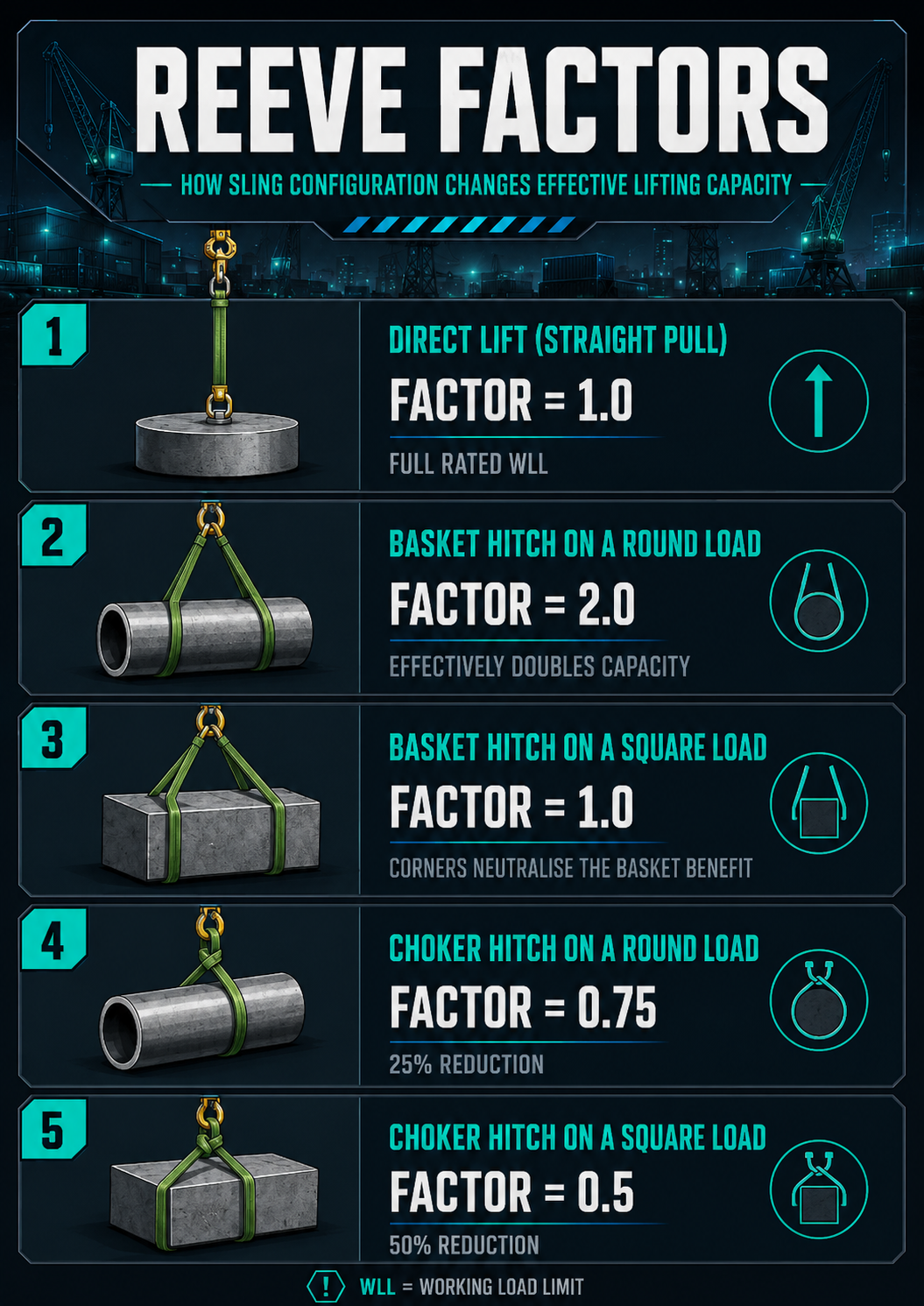
A reeve factor (sometimes called a load factor) is a multiplier applied to a sling’s WLL to account for how the sling is physically connected to the load. The way you attach a sling creates friction, bending, and compression forces that reduce the effective capacity of the sling below its rated WLL.
The formal definition: the reeve factor is the factor by which the WLL of a sling is adjusted to give its new WLL for a particular application in which the sling is reeved.
Think of it this way — a sling rated at 10 tonnes doesn’t automatically lift 10 tonnes if it’s wrapped in a choker hitch around a steel beam. The hitch configuration eats into that capacity, and the reeve factor tells you exactly how much.
Where do reeve factors come from?

Reeve factors are not arbitrary numbers — they come from physical testing and engineering mechanics that have been validated and codified into the Australian Standards governing lifting practice today.
The foundation is something engineers call the D/d ratio — the diameter of the object a sling bends around (D) divided by the diameter of the sling itself (d). Testing of wire rope established a clear relationship: the sharper the bend, the weaker the sling. When a sling cinches tightly around a load, the wires on the outside of the bend stretch while those on the inside compress, reducing the total force the sling can safely carry. A choker hitch forces exactly this kind of bend — and the sharper the contact point, the greater the reduction.
Load shape matters for the same reason. A round load allows the sling to bend gradually across a smooth surface. A square load forces the sling around a hard corner, concentrating stress at that point and eliminating much of the capacity the hitch would otherwise provide. That is why the same choker hitch configuration produces a factor of 0.75 on a round load and only 0.5 on a square one.
These values were formalised through Standards Australia in the AS 1666, AS 1353, AS 4497 and AS 3775 series, drawing on international research and decades of physical test data. They are intentionally conservative — designed to provide a safe margin across the full range of conditions a dogger or rigger might encounter on site.
When you apply the correct reeve factor you are applying the result of that engineering work. When you skip it, you are not just bending a rule — you are operating outside the load envelope the sling was designed and tested to handle.
Reeve factors for common sling configurations
The reeve factor you apply depends on two things: how the sling is hitched, and the shape of the load it’s wrapped around.
Here’s a summary of the standard reeve factors used in Australian dogging and rigging practice:
| Configuration | Load Shape | Reeve Factor | Effect on WLL |
|---|---|---|---|
| Direct Connection | Attachment Point | 1.0 | Full Rated WLL |
| Basket Hitch | Round Load | 2.0 | Doubles WLL |
| Basket Hitch | Square / Rect. | 1.0 | No Change |
| Choker Hitch | Round Load | 0.75 | 25% Reduction |
| Choker Hitch | Square / Rect. | 0.5 | 50% Reduction |
← swipe to scroll →
Why does load shape matter?
With a basket hitch on a round load, the sling distributes force evenly across a smooth surface — it behaves almost like two slings working together, hence the factor of 2. On a square load, the corners create stress concentration points that cut into the sling material and reduce the effective capacity, bringing the factor back to 1.0.
A choker hitch is even more severe. The sling wraps back on itself and cinches tight against the load. On a square load, that pinching effect combined with the corner stress drops the factor all the way to 0.5 — halving the sling’s effective WLL.
On Site Tip
Before you run any sling calculation, write down three things: the weight of the load, the hitch type you're using, and the shape of the load. Getting these three confirmed upfront means your reeve factor and angle factor selections follow naturally — and you're far less likely to grab the wrong value under pressure on site.
How reeve factors affect your effective WLL

The formula is straightforward:
Max Load = WLL × Angle Factor × Reeve Factor
Or if you need to work out the minimum WLL of the sling required:
Required WLL = Load Weight ÷ Angle Factor ÷ Reeve Factor
Worked example 1 — Finding max load:
Two slings, each with a WLL of 8 tonnes, are used at a 60° included angle and reeved in a choker hitch around a square load.
- Angle factor at 60° = 1.73
- Reeve factor (choker, square) = 0.5
- Max load = 8 × 1.73 × 0.5 = 6.92 tonnes
- Even though you have two 8-tonne slings, the effective lifting capacity of that rig is just under 7 tonnes.
Worked example 2 — Finding required WLL:
You need to lift a 4-tonne square load using two slings at a 60° included angle in a choker hitch configuration. What WLL do you need per sling?
- Weight = 4 t, Angle factor = 1.73, Reeve factor = 0.5
- Required WLL = 4 ÷ 1.73 ÷ 0.5 = 4.62 tonnes per sling
Reminder
The reeve factors on this page apply to FSWR, chain, and synthetic slings as a general guide. Always cross-check your final sling selection against the manufacturer's load chart or WLL table for your specific sling — rule-of-thumb calculations are for estimation and study purposes only. On site, the manufacturer's data is the authoritative source.
Try the reeve factor calculator

Before you rig it, run the numbers.
Use the calculator below to see how load weight, sling configuration, and angle combine to affect the effective WLL of your lift setup.

See How Reeve Factors Affect Your Sling
Select a sling or chain, set your load weight and hitch type — see effective WLL, remaining capacity, and how every configuration compares at a glance.
| Configuration | Load Shape | Reeve Factor | Combined Factor | Effective WLL | % Used | Status |
|---|
Reeve factors vs angle factors — What's the difference?

These two factors are often confused by students. Here’s the quick distinction:
Angle factor — accounts for the increased tension in each sling leg as the angle between them opens up. The wider the angle, the more each sling is being pulled outward rather than lifting vertically, so each leg carries more than its share of the load.
Angle factor
Accounts for the increased tension in each sling leg as the angle between them opens up. The wider the angle, the more each sling is being pulled outward rather than lifting vertically, so each leg carries more than its share of the load. Learn more about sling angles from our detailed Toolbox or use the calculator to adjust weight and angle to sling leg tension.
Reeve factor
Accounts for how the sling physically connects to and wraps around the load. It’s about hitch type and load geometry, not angle.
In most real lifts, both factors apply at the same time. That’s why the full formula multiplies them together: Max Load = WLL × Angle Factor × Reeve Factor.
Why you must never ignore the reeve factor

On site, it can be tempting to just grab a sling that looks big enough and wrap it around the load. But ignoring the reeve factor means you could be attempting a lift that exceeds your sling’s actual working capacity — even if the marked WLL looks sufficient.
Regulators and industry standards are clear: all factors must be considered when determining which sling is correct for a given load. That includes the reeve factor, the angle factor, and the weight of the load. And remember — always refer to the manufacturer’s load charts for accurate WLL data. Rule-of-thumb calculations are useful for studying and quick checks, but they’re not a substitute for proper documentation.
Related: Sling angles explained & Dogging VOC practice questions.
The importance of a rigging cheat sheet
While understanding the mathematics behind sling angle calculations is essential, doggers and riggers in industry commonly rely on approved rigging check cards to confirm load factors quickly and safely.
A rigging check card provides:
- Angle factor tables
- Load factor charts
- Working Load Limit (WLL) guidance
- Quick reference lifting information
These cards are designed to reduce calculation errors and provide a practical field reference during lift planning.
For example, the Bullivants Rigcheck Card includes included angle charts and load factor tables consistent with industry lifting practice.
It is important to remember that a rigging check card is a guide only and does not replace proper lift planning, consideration of reeve factors, dynamic loading, centre of gravity, or compliance with relevant Australian Standards.
Quick recap
What is a reeve factor?
A reeve factor is the factor by which the WLL of a sling is adjusted to give its new WLL for a particular application in which the sling is reeved.
What are the reeve factors for common sling configurations?
- Direct lift (straight pull): Factor = 1.0 — full rated WLL
- Basket hitch on a round load: Factor = 2.0 — effectively doubles capacity
- Basket hitch on a square load: Factor = 1.0 — corners neutralise the basket benefit
- Choker hitch on a round load: Factor = 0.75 — 25% reduction
- Choker hitch on a square load: Factor = 0.5 — 50% reduction
Does basketing a load always double the WLL?
No. A basket hitch on a round load has a reeve factor of 2.0, but the same hitch on a square or rectangular load has a factor of 1.0. The shape of the load matters because square corners concentrate stress on the sling.
Do reeve factors apply to all sling types?
Yes — reeve factors apply to wire rope (FSWR), chains, and synthetic slings.
Remember: Always check the manufacturer’s data for your specific sling type.
Are reeve factors tested in VOC assessments?
Yes. Reeve factors (also called load factors) are a core calculation topic in dogging, basic rigging, and intermediate rigging VOC assessments in Australia.
What percentage reduction applies when using a choker hitch on a square load?
A choker hitch on a square or rectangular load reduces the sling’s WLL by 50%. This is because the corners of the load create stress concentration points, and the cinching action of the hitch adds further load on the sling material. The reeve factor applied is 0.5.
What percentage reduction applies when using a choker hitch on a round load?
A choker hitch on a round load reduces the sling’s WLL by 25%, giving a reeve factor of 0.75. The smooth, curved surface distributes the load more evenly than a square load, so the reduction is less severe.
What are the three main factors that determine the length and capacity of slings required for a two-leg lift?
The three factors are:
1. The mass (weight) of the load
2. The included angle between the sling legs, and
3. The method of slinging — that is, whether the slings are directly connected, in a basket hitch, or in a choker hitch. All three must be considered together before selecting your slings.
When using a basket hitch on a round load, what load factor applies and why?
A basket hitch on a round load has a reeve factor of 2.0. Passing the sling under a round load and connecting both eyes to the hook is effectively equivalent to using two separate slings, so the lifting capacity doubles relative to a single straight lift.
If a sling has a WLL of 5 tonnes and is used in a choker hitch around a square load, what is the effective WLL?
The effective WLL is 2.5 tonnes. Apply the reeve factor of 0.5:
5 × 0.5 = 2.5 tonnes. This is why selecting a sling based only on its marked WLL without applying the reeve factor is a serious error.
What formula is used to calculate the maximum load when both a reeve factor and an angle factor apply?
The formula is: Max Load = WLL × Angle Factor × Reeve Factor. Both factors must be applied together — ignoring either one will result in an incorrect and potentially unsafe calculation.
Does the reeve factor apply when a sling is directly connected to a rated lifting point on the load?
No. When a sling is connected directly to a manufacturer-rated attachment point on the load — such as a lifting lug or eye bolt — the reeve factor is 1.0, meaning no reduction is applied. The full marked WLL of the sling is available for that configuration.
Getting comfortable with reeve factors isn’t just about passing your VOC — it’s a core part of understanding how a sling actually behaves in the field. Use the calculator above to run through your own scenarios, and bookmark this page as a study reference. If you want to practise answering real VOC-style questions on this topic, head over to our Dogging VOC Questions or Basic Rigging VOC Questions pages.
Resources & references:
Industry Guides
- Dogging and Rigging Guide — Transport for NSW (2024). The nationally consistent reference guide covering dogging, basic, intermediate and advanced rigging. Covers load assessment, sling selection, hitch types, reeve factors, and High Risk Work Licence requirements.
- A Guide for Riggers — WorkCover NSW. The foundational NSW reference used in VOC assessments, covering all sling calculations including reeve and angle factors with worked examples.
- Mobile Crane Code of Practice 2006 — Workplace Health and Safety Queensland. Covers the legal framework for crane and lifting operations under the Work Health and Safety Act 2011 and WHS Regulation 2011.
- High Risk Work Licensing for Dogging — Safe Work Australia Information sheet outlining the national licensing requirements for dogging work in Australia.
- Wire Rope Users Manual — Wire Rope Technical Board (USA), covers D/d ratio efficiency curves with the underlying test data
- Wire Rope Engineering Handbook — A.O. Bird and D.A. Rawlings — one of the few texts that goes into the physics of wire rope bending and efficiency in detail
Australian Standards
These standards set the product specifications, WLL requirements, and care and use guidelines for all sling types used in Australian workplaces. WLL tables in these documents are the definitive reference — rule-of-thumb calculations are for estimation only.
- AS 1666.1 — Wire Rope Slings: Product Specification
- AS 1666.2 — Wire Rope Slings: Care and Use
- AS 1353.1 — Flat Synthetic Webbing Slings: Product Specification
- AS 1353.2 — Flat Synthetic Webbing Slings: Care and Use
- AS 4497 — Round Slings: Synthetic Fibre
- AS 3775.1 — Chain Slings for Lifting Purposes: Grade T(80) and V(100)
- AS 3775.2 — Chain Slings for Lifting Purposes: Care and Use
- AS 3776 — Lifting Components for Grade T and Grade V Chain Slings
- AS 2550.1 — Cranes, Hoists and Winches: Safe Use — General Requirements
- AS 3569 — Steel Wire Ropes: Product Specification
- AS 2759 — Steel Wire Ropes: Use, Operation and Maintenance
- ASME B30.9 (USA) — Slings standard, includes technical background on hitch efficiency
- ISO 4778 — Wire rope sling specifications with technical basis
Australian Standards are available at standards.org.au
Legislation
Dogging and rigging are classified as High Risk Work in Australia. The following legislation applies:
- Work Health and Safety Act 2011 (WHS Act)
- Work Health and Safety Regulation 2011 (WHS Regulation)
Your state or territory regulator is the primary point of contact for licensing, compliance, and incident reporting.
Regulators – State and Territory
National – Safe Work Australia
Queensland – WorkSafe Queensland
New South Wales – SafeWork NSW
Victoria – WorkSafe Victoria
Western Australia – WorkSafe WA
South Australia – SafeWork SA
Northern Territory – NT WorkSafe